

Richard Mathieson


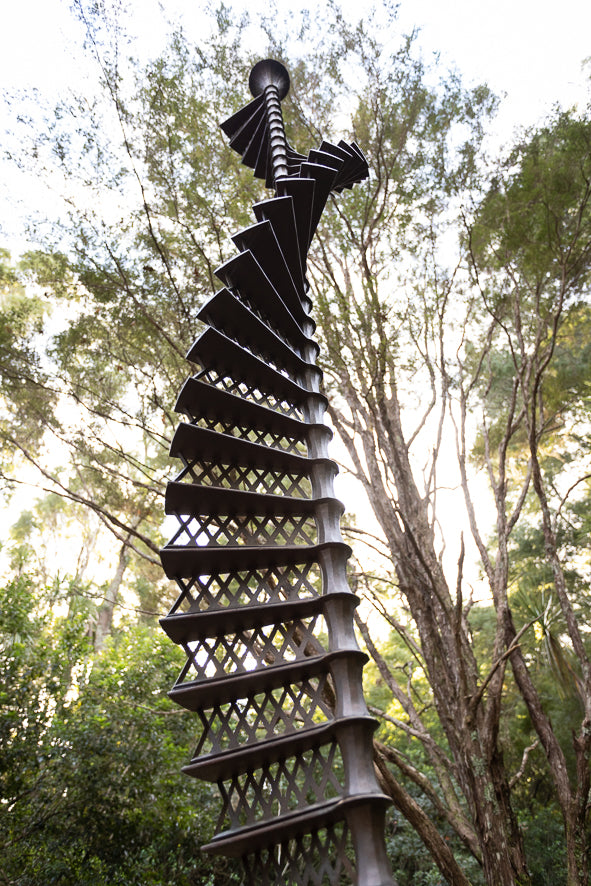
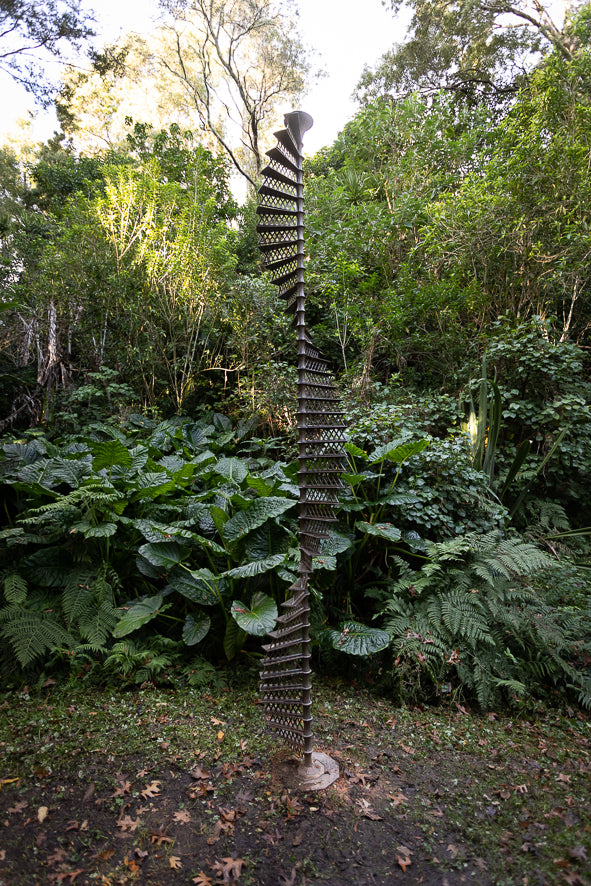
42 Steps, 2006
Sand cast bronze, stainless steel
3200 x 350 x 350 mm
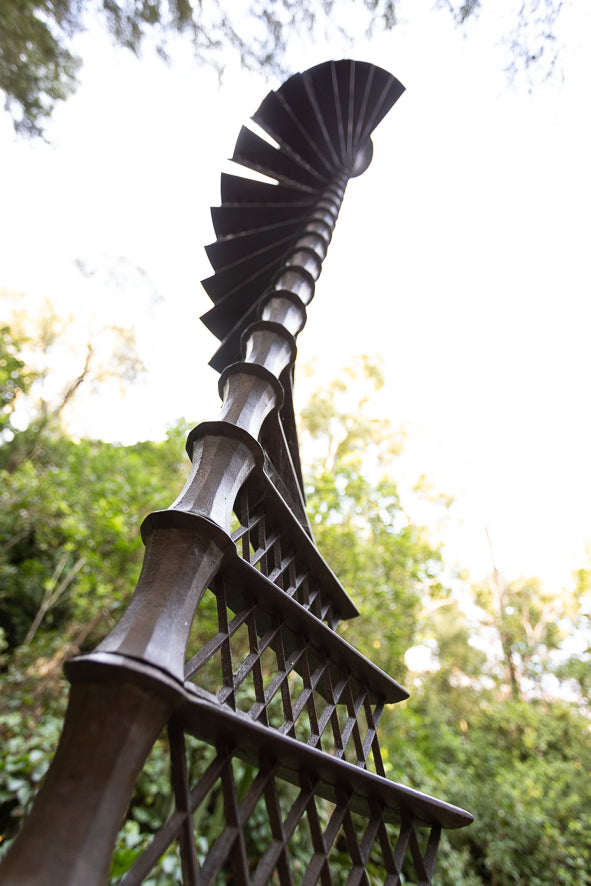
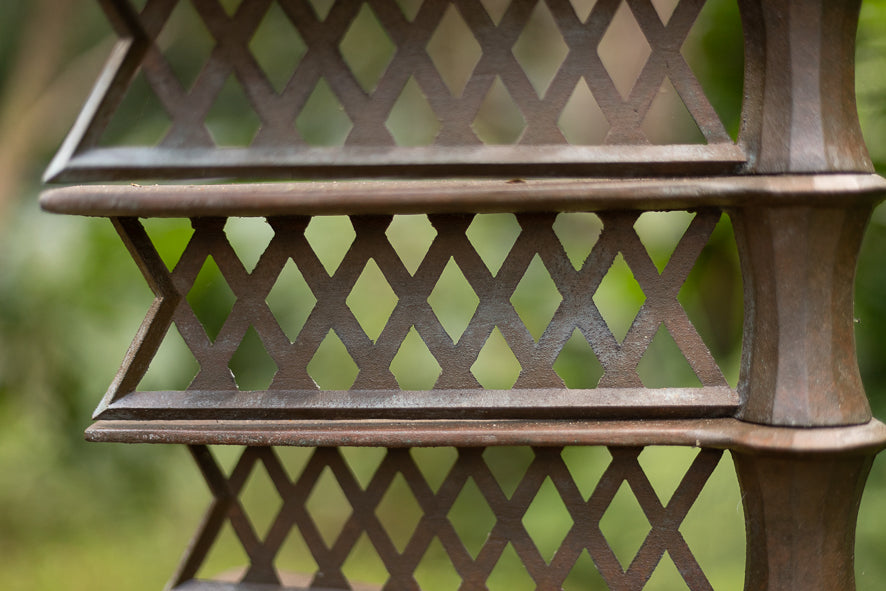
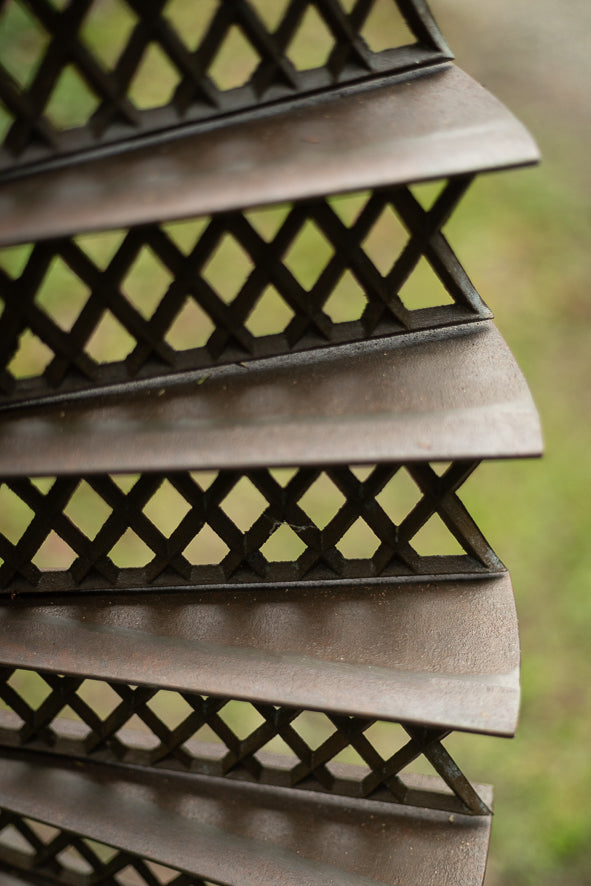
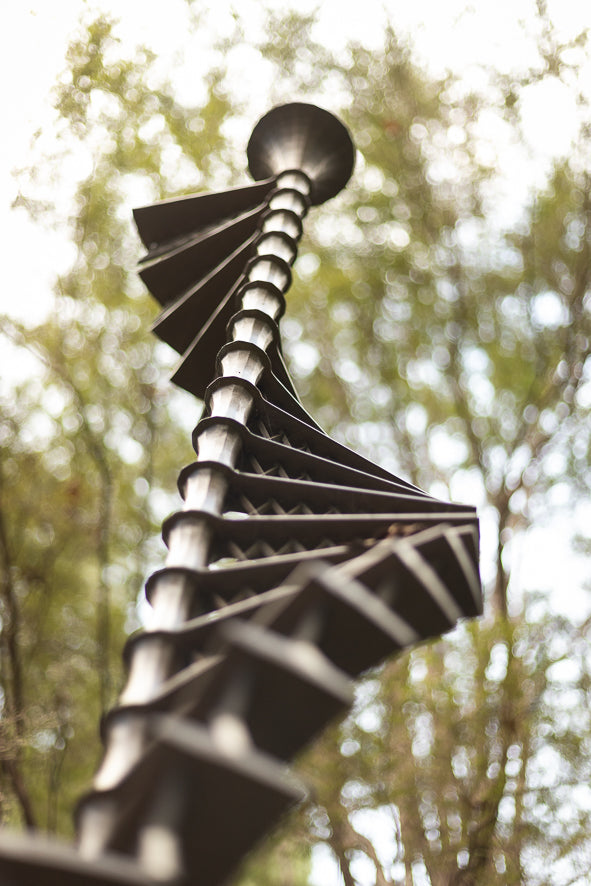
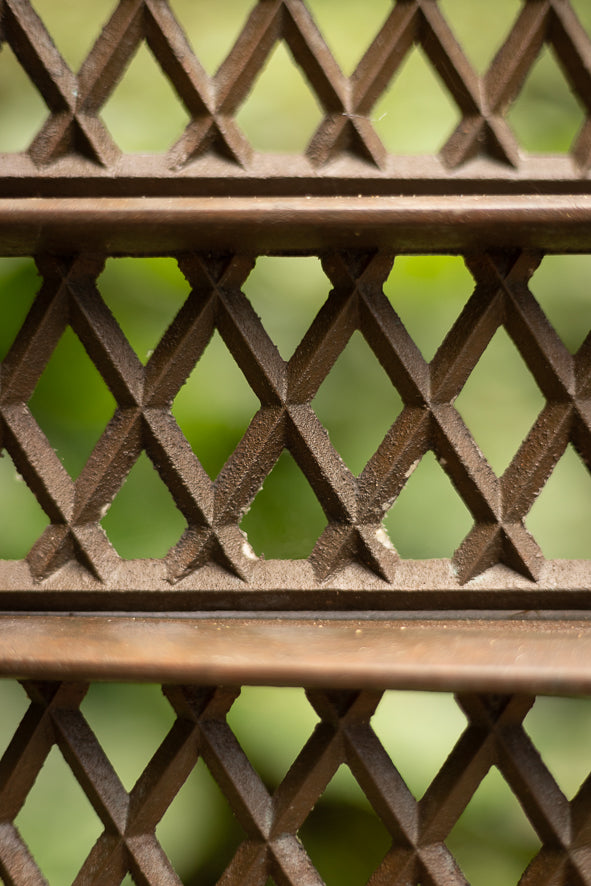
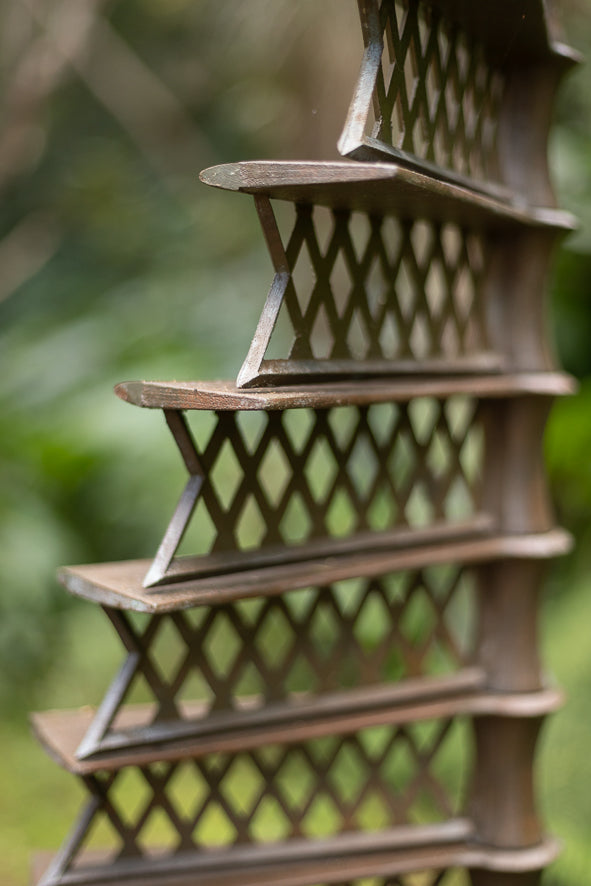
Rising in a slender, spiralling form, 42 Steps draws the eye upward, evoking the quiet ascent of a staircase reaching toward the sky. Composed of repeating cast bronze elements threaded around a central axis, the work reflects Richard Mathieson’s long-standing interest in the helix — a form that is at once structural, lyrical and seemingly without end. The diamond-patterned steps allow light to pass through at shifting intensities, creating a subtle play of shadow and movement as the viewer circles the work.
Mathieson’s practice frequently explores modular repetition and the act of building through accumulation. Each step in 42 Steps was individually cast using a green sand moulding process, a method that allowed for both precision and variation. The work’s construction — a sequence of elements revolving around a central core — has been likened by the artist to threading a necklace, balancing technical discipline with an intuitive sense of form.
The helix remains a central motif throughout Mathieson’s work — a shape that suggests growth, continuity and the passage of time. In 42 Steps, this spiralling structure becomes a quiet meditation on existence, carrying the viewer’s gaze upward in a continuous, unbroken motion.
Reflecting on the work, Mathieson connects it to a whakataukī referenced in Witi Ihimaera’s memoir Māori Boy: “Te tōrino haere whakamau, whakamuri” — as the spiral moves forward, it also returns. This idea of simultaneous progression and return offers a meditation on time, existence and continuity, carried through the work’s endless upward movement.
More from this artist
Artist Bio

Richard Mathieson was born in the Wairarapa and raised in Taranaki. His family moved to Stratford when he was four. He attended New Plymouth Boys High School where he was fortunate to have painter Tom Kreisler as his art teacher. Tom encouraged Richard to go to Art School; he studied sculpture at Elam from 1980 - 1985 with Greer Twiss and Christine Hellyar.
From 1986 -1990, Richard co-directed Star Art Gallery in Karangahape Road with art school friend John Irving. This project furthered Richards interest in presenting art to the public, a passion he gained after working at the Govett Brewster Art Gallery in New Plymouth during summer breaks while at Elam. Star Art's focus was to promote Richard's and John's contemporaries from all disciplines. There were no galleries championing their age group at the time.
In 1989 Richard received a QEll Arts Council Grant for his first solo exhibition, and that year Star Art hosted the inaugural exhibition of the New Zealand Contemporary Medallion Group, now called Medal Art NZ (MANZ). Richard is a long time member of MANZ, he acted as convenor from 2001 - 2007. After many outings MANZ is still going strong, now showing with Artis Gallery and has over 30 exhibiting members.
The curation and presentation of sculpture shows, indoors and out, has been been a strong, ongoing interest of Richard's, running parallel to his sculpture practice. He has created and designed furniture for many of the MANZ shows. A major project was the MANZ 25th Anniversary show in 2015 that travelled to four major institutions throughout Aotearoa.
In 2007 Richard was instrumental in the creation and development of the Sculpture in the Gardens project at the Auckland Botanic Gardens. A major biennial summer long outdoor sculpture show that feeds into a burgeoning permanent NZ sculpture collection. There are now 25 significant sculptures sited through the Gardens.
Richard has tutored sculpture as part of the Artist in Schools programme with Orewa College and Remuera Intermediate which resulted in large bronzes being made for the schools. There have also been other collaborative projects eg the 2015 Summer of Sculpture at the Wynyard Quarter on Auckland's waterfront.
Richard's choice of materials are mainly wood and bronze. He often utilises the ancient method of sand casting - pouring bronze into sand moulds (both hard sand and green sand), making the patterns out of wood. For small works, like medals, he also uses the lost wax / ceramic shell process. Though his work is essentially abstract it has a formal, mathematical quality, often using repetition and a modular approach to shape making.
He has exhibited widely in New Zealand and undertaken several public and private commissions. Richard and his family live in South Auckland.