

Graham Bennett


Position Fixing, 2007,
Stainless steel, 3150mm X 7600mm X 130mm
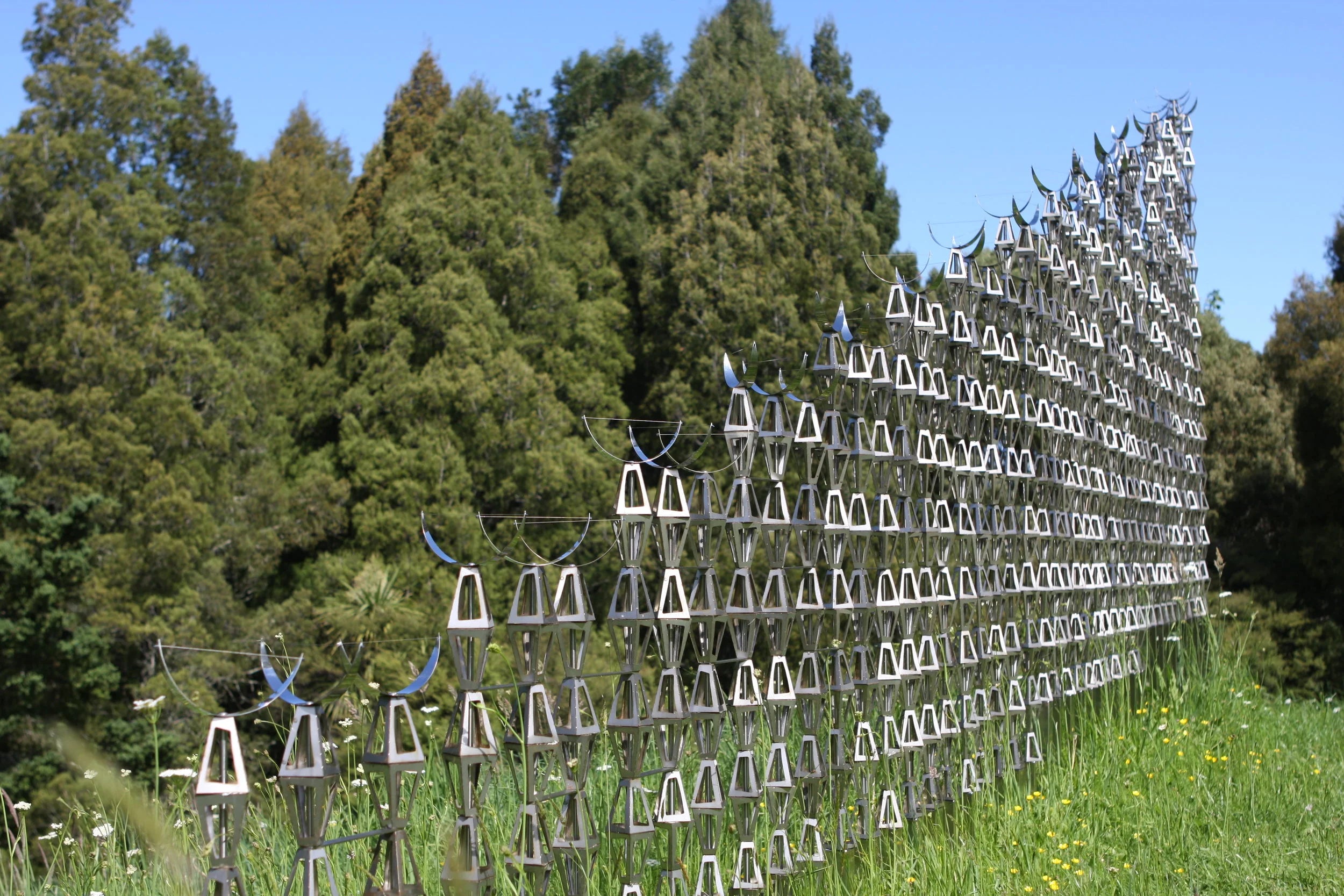
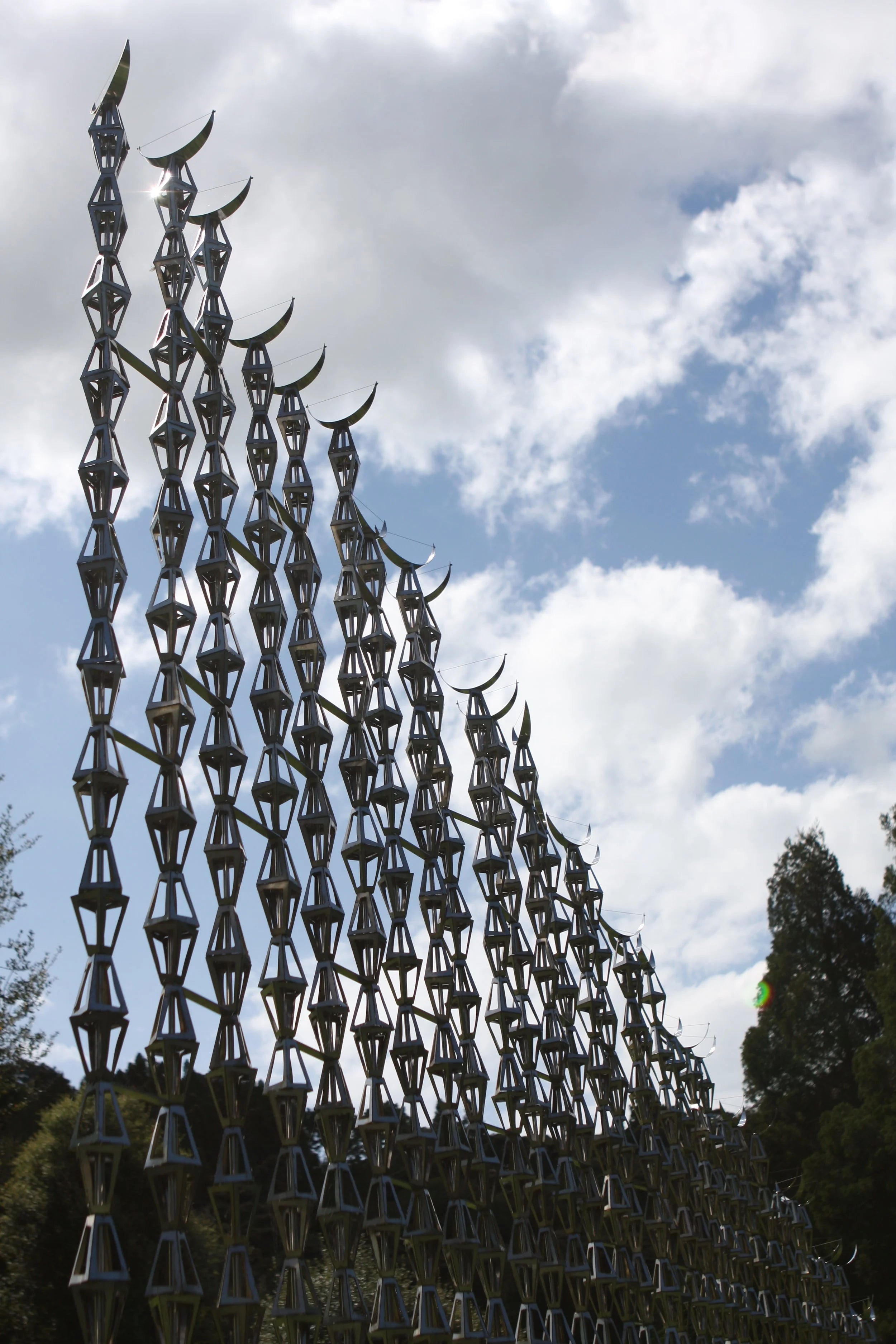
Take forty five Endless Columns by Brancusi, hollow them out and place them in a row in Aotearoa New Zealand. This could be a literal description of Graham Bennett’s Position Fixing. The resultant chain link fence Graham Bennett creates makes for an impressive site on the walkway at Brick Bay. As a narrative of people and place it suggests fragile cultural strings linked together.
Beyond the physical, Bennett’s sculptures deal directly with relationships between people, place and identity, with particular reference to the Pacific region. In large scale public situations and in more intimate gallery spaces, Bennett constantly asks questions about the fragile world we inhabit and the nature of interactions, physical and social.
Position Fixing fascinates viewers by its sheer scale. People start counting the vertical poles. There are 45 of them. And there are over one thousand elements, hand folded prisms, threaded over the towers. In their form, repetition and the threading technique, one cannot go past Brancusi’s iconic column of cast iron ‘beads’. This distinctive shape also has an affinity with the geometric border patterns of the Pacific.
Atop each tower sits a polished crescent. These represent siting devices, a celestial indicator or reference. Graham Bennett often references mapping and navigational aids in his on-going exploration of location in time and place. To that end Position Fixing is carefully placed in a line that references the south/west, north/east trajectory of our islands, a line that extends out across the Pacific through the Tonga Trench. It suggests pathways across the Pacific, Te Moana Nui a Kiwa, that emanate from Aotearoa New Zealand.
Position Fixing with its longitudinal and latitudinal markers each tensioned by a horizon or site line, articulates ideas about marking territory, making claims, movement, mapping and measurement. It talks of repetition or cycles - tidal and celestial - and of perceptions, internal and external.



More from this artist
Artist Bio
Born in Nelson, New Zealand in 1957, Graham Bennett graduated from the University of Canterbury School of Fine Arts, where he trained in photography in 1971. He now lives and works in Christchurch as a full-time artist.
His growing interest in three-dimensional forms, particularly the human figure, lead him to focus on sculpture, working in stainless steel, bronze, wood and stone, although a wide-ranging practice including teaching, has seen him also working with printmaking, rug design,and mixed-media drawings.
His work shows a fascination with mapping and navigation and the relationship between people and place: "My work is a convoluted journey of tangents and overlays, providing opportunities to trigger questions for myself and others about who, where and when we are or perhaps to challenge what balance means in our life, actions and relationships with the earth and with others."
Throughout his career Bennett has had more than fifty exhibitions including ten in group shows in Japan and he has received numerous prestigious awards and grants, residencies and private and public commissions, both within New Zealand and internationally. His work is held in public and private collections in New Zealand, Australia, England, France, Spain, USA and Japan.
In 2012 Bennett was one of five international artists chosen to participate in the Seoul International Sculpture Festa. His commissioned work, Tipping Point, was installed permanently in the Crown Haitai's Art Valley Sculpture Park and was also chosen as the predominant image for the symposium’s marketing design.
In 2020, an exhibition titled Seeking a Balance opened at Christchurch Art Gallery Te Puna o Waiwhetū, showcasing a mix of sculptures, drawings and large-scale projections of some of Bennett’s larger environmental sculptures, and celebrating his remarkable 50-year career.