

Gregor Kregar


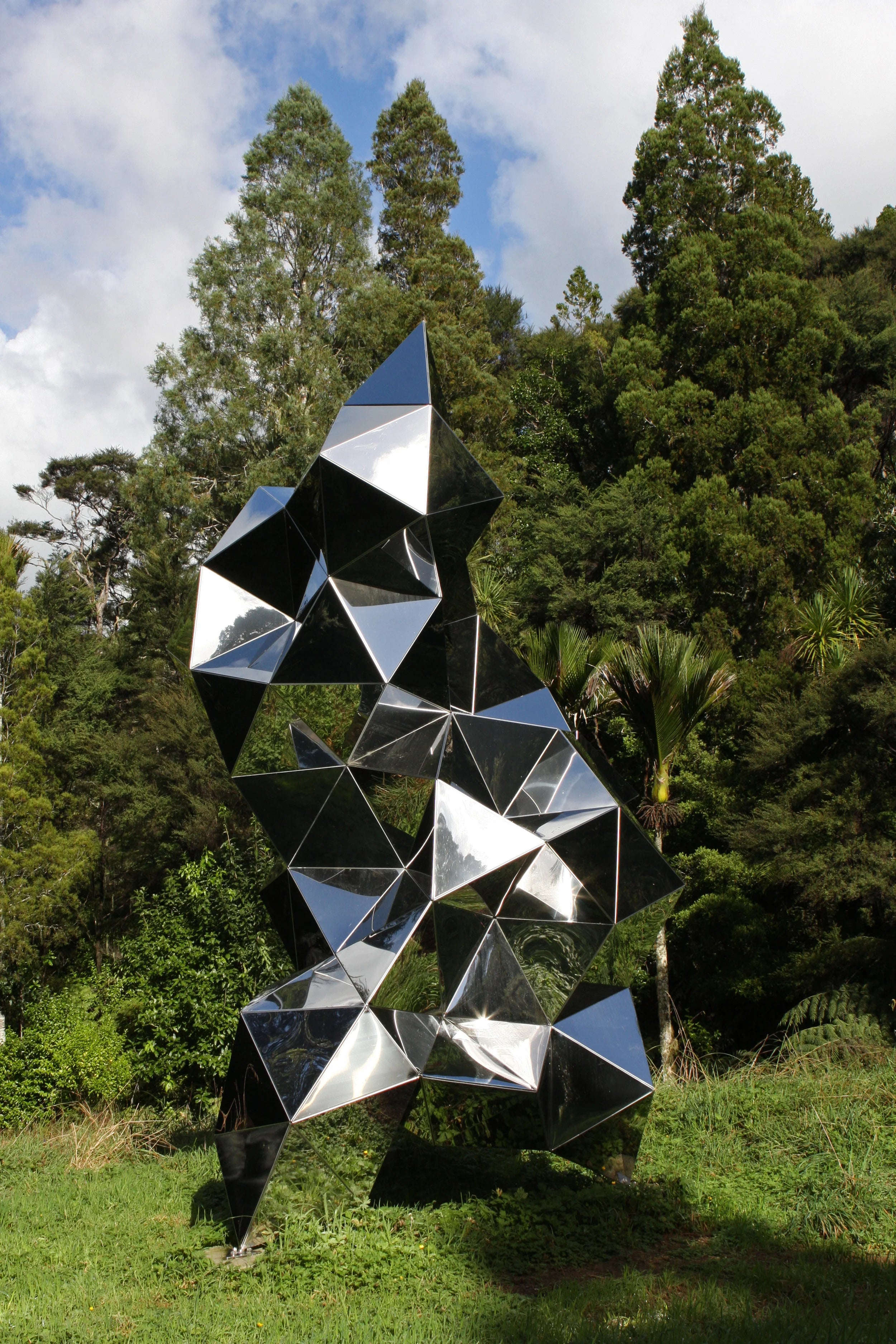
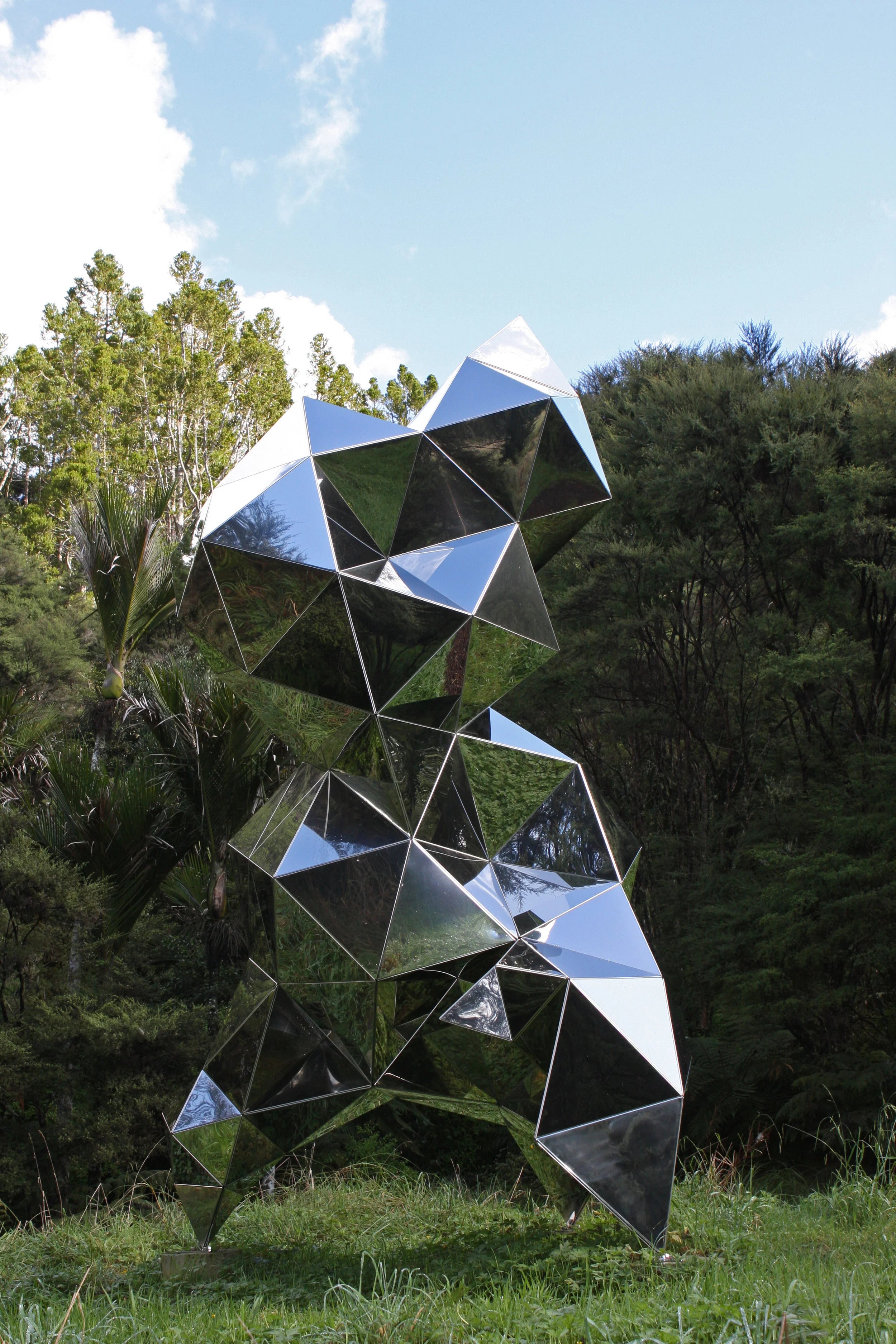
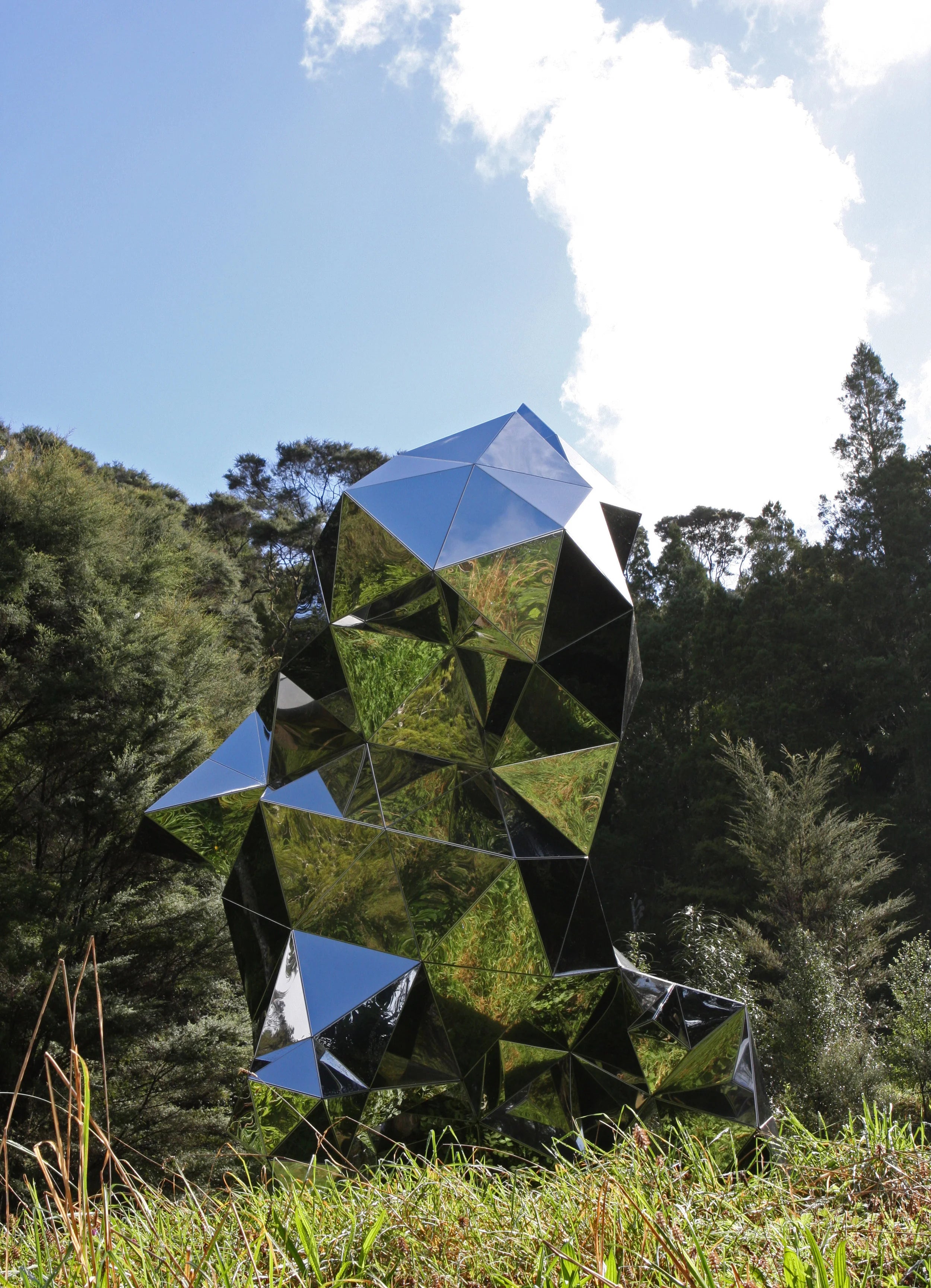
Polyhedron, 2006,
Stainless steel, 5100 x 3400 x 3400mm
Gregor Kregar studied fine arts in Slovenia before completing a Master of Fine Arts at the Elam School of Fine Arts in Auckland in 1999. His figurative and abstract sculptures are often comprised of a broad range of materials and convey a sense of the uncanny.
Recent sculptures reveal Kregar’s interest in geometric mathematical structures and their combinations and multiplications found in nature. Like Prstan, his winning entry in the 2000 Wallace Art Awards, Kregar’s Brick Bay Polyhedron is an investigation of ancient Platonic and Archimedean solids. A laser-cut, stainless steel Icosi-dodecahedron over five metres in height, the work grows into an Icosahedron, a Tetrahedron and other geometric shapes. Resembling a ‘blown up’ conglomeration of molecular structures, Polyhedron focuses on the aesthetic, formal and chemical similarities of natural formations such as crystals, ice and mountains.
Initially, Brick Bay’s highly polished Polyhedron appears as a foreign – even alien – intrusion upon the landscape. Upon closer inspection, however, the artwork replicates it physical environment. Paddocks, trees, water, even viewers are reflected in the sculpture. In turn, its very shape echoes the macrocosmic construction of natural elements by imitating natural molecular systems.
Kregar observes, “In nature everything is built out of three basic triangular systems and their combinations and multiplications.” The molecular structures that generate these natural forms are constructed in the shape of Platonic and Archimedean solids. Archimedean solids are derived from the five Platonic solids; the cube, the dodecahedron, the Icosahedron, the octahedron and the tetrahedron. Described by Plato as ‘cosmic figures,’ each shape was aligned with the elements of fire, air, water and the materials of which the constellations and heavens were made. Thus Polyhedron embodies the very essence of the environment; visualising the unseen in the organic.

More from this artist
Artist Bio
Gregor Kregar was born in Slovenia in 1972 and received his BFA from the Academy of Fine Arts, University of Ljubljana, Slovenia before moving to New Zealand and gaining a Master of Fine Arts from Elam Art School, Auckland.
Kregar is known for his diverse sculptural practice, working with materials such as glass, stainless steel, wood, plastic and stoneware and often accompanies his sculptures with light installations, soundtracks, photography and video.
“My practice is driven by ideas and I choose materials or media according to the concepts in my work,” says Kregar. “Part of what I find exciting about sculpture is experimenting with a range of different techniques and properties. I like pushing the limit of materials, taking them outside of their usual use or historical context, creating an element of surprise for the viewer.”
Kregar’s sculptures are often large-scale, commanding the attention of the viewer and deliberately subverting audience expectations. He often experiments with mundane subjects, playing with scale and repetition, creating a more curious and thought-provoking object.
He reflects: “I do like the idea that sculpture can potentially hold this more democratic value, apart from being viewed as a beautiful object. Quite often what people respond to and what so-called art experts respond to is different, but in that work I managed to push buttons for both audiences. I think it’s really good to see that contemporary art can do that. I enjoy it when works are successful on different levels.”
Kregar has exhibited widely in New Zealand and internationally, including Australia, the U.S.A, the U.A.E, Qatar and Europe. He has been invited to participate in several New Zealand and international art residency programmes, including in China and the United States. His work has been included in prestigious collections in New Zealand and around the world, such as Te Papa Tongarewa, Auckland Airport, Christchurch Art Gallery and the Francis J. Greenburger Collection in New York. His work has been recognised by multiple awards, including the 2000 Wallace Art Award.
Kregar now divides his time between New Zealand and the pursuit of projects and residencies overseas, which he says helps to keep his practice fresh and engaged with the wider art community: “Sculpture is always about solving problems. It engages me intellectually and physically – I like the boundless possibilities of what it can or could be. Also for me, sculpture is connected closely to reality and the world that surrounds us.”
-
 A Sound of Thunder: Orange TriceratopsA Sound of Thunder: Orange Triceratops
Gregor Kregar
+ Learn More- Regular price
-
$0.00 - Regular price
-
- Sale price
-
$0.00
-
 Diplodocus (Blue Copper Patina)Diplodocus (Blue Copper Patina)
Gregor Kregar
+ Learn More- Regular price
-
$850.00 - Regular price
-
- Sale price
-
$850.00


